BlogResearch
Can ChatGPT read sheet music?
We gave the same page of piano music to ChatGPT models as a clean PDF and as a phone photo, scored every note against the printed score, then read the same files with ScoreStarling.
The short answer
Better than its reputation, on a clean page. In our test on October 13, 2026, the best of seven ChatGPT models read 16 bars of a printed Bach minuet with 1 or 2 wrong notes out of 101, and got the key and time signature right every time. The model matters most: the weakest got about 90 wrong on the same clean PDF. A photo of the page made results swing, from 1 to 37 wrong for the stronger models. In the ChatGPT app it could make a MIDI file of what it read, mistakes included, but nothing you could edit as a score. Connect a sheet-music reader such as ScoreStarling and the same chat reads the PDF into a score you can hear, transpose and download as MusicXML or MIDI.
What we tested
We used three pieces of public-domain music, typeset by the Mutopia Project, and scored every note an answer gave against the printed score.
| Page | What it is | Bars scored | Notes |
|---|---|---|---|
| A. Clean PDF | Minuet in G, BWV Anh. 114 (attributed to Christian Petzold), one page | 1–16 | 101 |
| B. Phone photo | The same page, angled, with uneven light and a shadow; we made it from the PDF to imitate a phone shot | 1–16 | 101 |
| C. Harder page | Chopin, Waltz in B minor, Op. 69 No. 2: pickup, accidentals, left-hand chords | pickup and 1–8 | 91 |
We sent each page three times to each of seven models offered with a ChatGPT subscription: gpt-6.1-sol, gpt-6-astra, gpt-6-sol, gpt-6-luna, gpt-5.6-sol, gpt-5.6-terra and gpt-5.6-luna. These were direct requests to the models with the image attached, without the ChatGPT app’s browsing or code tools, and which of them the app picks for you depends on your plan and settings. We also asked gpt-6.1-sol four questions a musician would ask: the key, time signature and notes of bars 1–4; the first eight bars transposed to F major; a version to play back or a MIDI file; and what is hard in bar 5. To count errors, we asked every model for every note of the scored bars with its octave and length.
We then asked the same questions in the ChatGPT app itself (chatgpt.com, GPT-6 at its default Medium thinking), once with the PDF and once with the photo, and took screenshots.
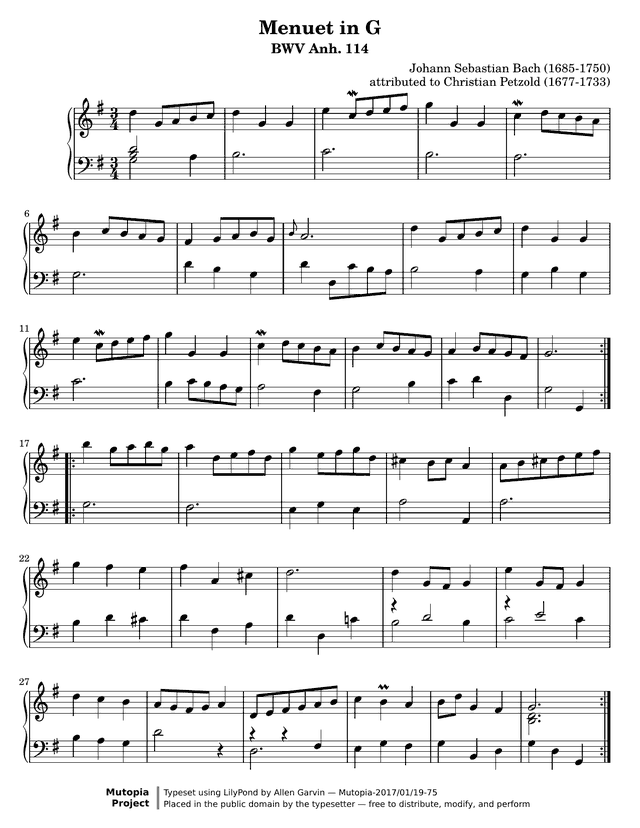
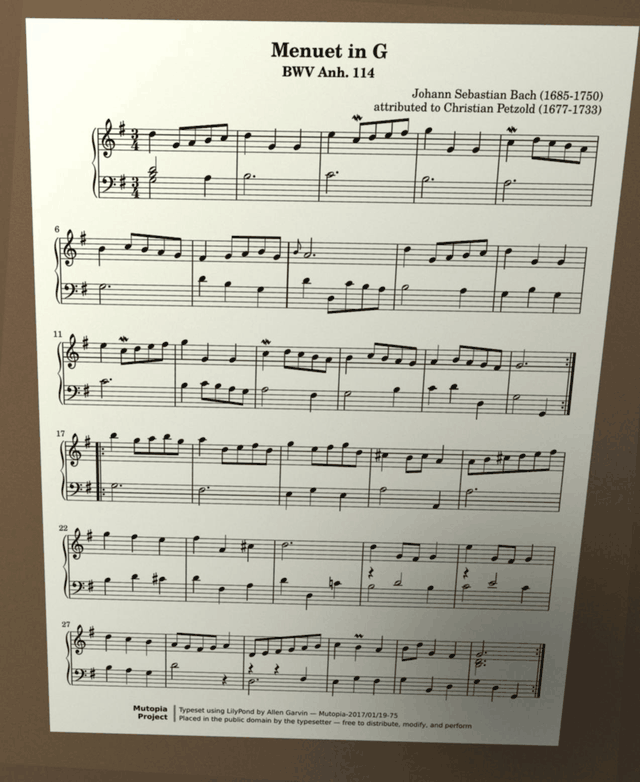
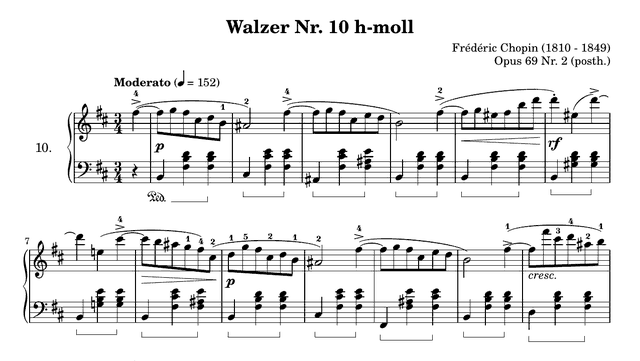
You can try the same pages yourself: the clean PDF and the photo.
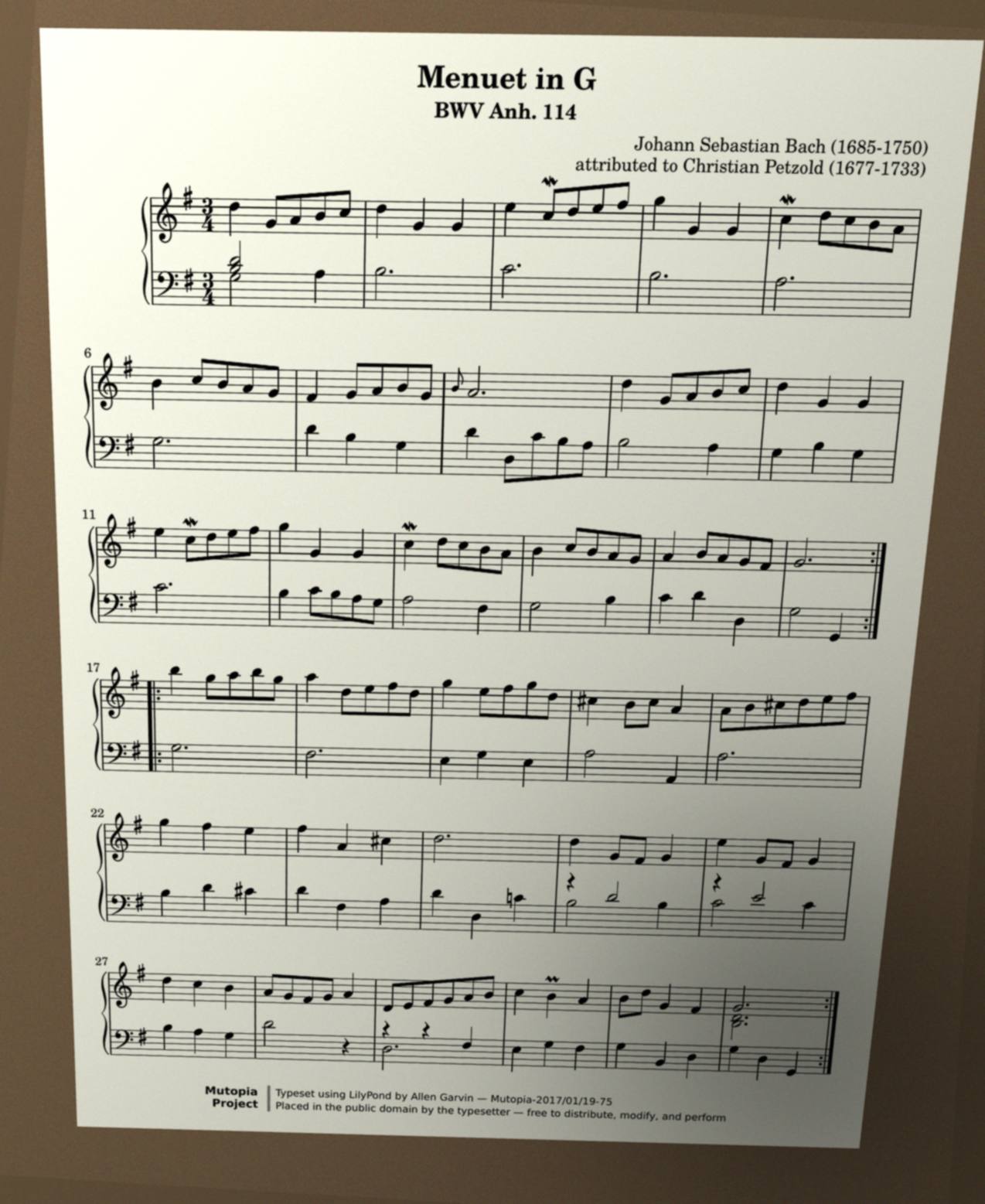
Each written note counts once, so a three-note chord counts three. A wrong pitch, a missing note or an extra note is a pitch error; a right pitch with the wrong length is a rhythm error. When a whole bar is read one step high, every note in it counts as wrong. Ornaments and grace notes weren’t counted.
What ChatGPT gets right on its own
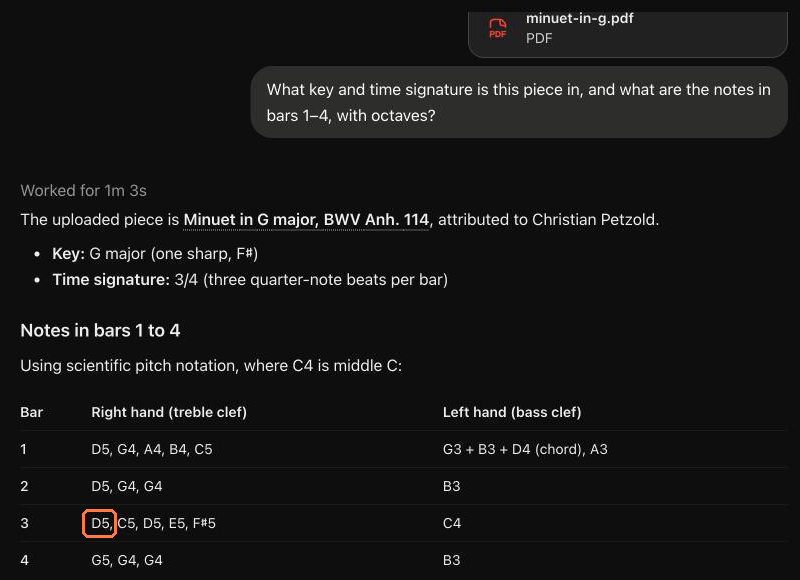
On a clean page, with a strong model, a lot. Every answer from the stronger models named the key and time signature correctly. gpt-6-astra read the clean minuet with 1, 2 and 1 wrong notes in its three tries and the Chopin with none; gpt-6.1-sol got 1, 5 and 0 on the minuet and 0, 0 and 2 on the Chopin. Asked to transpose eight bars from G major to F major, it moved every note down a whole tone, changed the key signature to one flat and kept the mordents and the grace note. Its advice on bar 5 was sensible practice advice: play the mordent lightly without delaying the beat, keep the eighth notes even, hold the left hand for all three beats.
Where it goes wrong
Three things went wrong in our test: weaker models, photos, and files.
The page
gpt-6.1-sol, clean PDF (5 wrong in bars 1–16)
gpt-6.1-sol, phone photo (37 wrong)
gpt-6-luna, clean PDF (62 wrong)
Weaker models
The model made a bigger difference than anything else. On the same clean PDF, gpt-6-sol and gpt-5.6-sol got 1 to 5 notes wrong per try, gpt-5.6-terra once got 37 wrong, gpt-6-luna got about 60 wrong, mostly bars read one step off, and gpt-5.6-luna got 86 to 97 wrong. On the Chopin, gpt-6-sol got up to 42 wrong and gpt-5.6-sol up to 59. gpt-6-luna declined to answer in two of three tries on the photo and the Chopin, once saying it couldn’t “reliably transcribe every note and duration”. Which model answers depends on the plan and settings you use, so the best results here are the best case, not the typical one.
Photos
Photos made every model less predictable. gpt-6-astra read the photographed page with 1, 1 and 13 wrong notes; gpt-6.1-sol with 11, 37 and 18. The mistakes weren’t random: in one try, bar 7’s F♯4 G4 A4 B4 G4 became A4 B4 C5 D5 B4, the whole bar a third too high; in another, the right hand of bars 5–7 and 11–15 was read one step too high throughout. A note’s pitch is its place on the five lines, and on a tilted, shadowed page it is easy to count one line off.
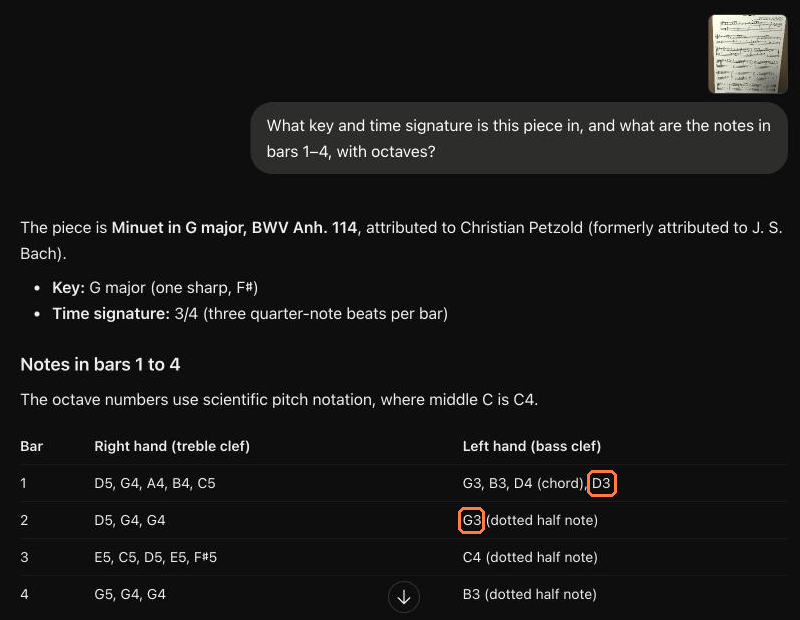
The model can also change its mind. In the photo conversation it read bars 3 and 4 one step too low, then, asked to transpose, opened with “Correction to my earlier reading” and fixed them. The same picture can give different notes on different questions.
Files
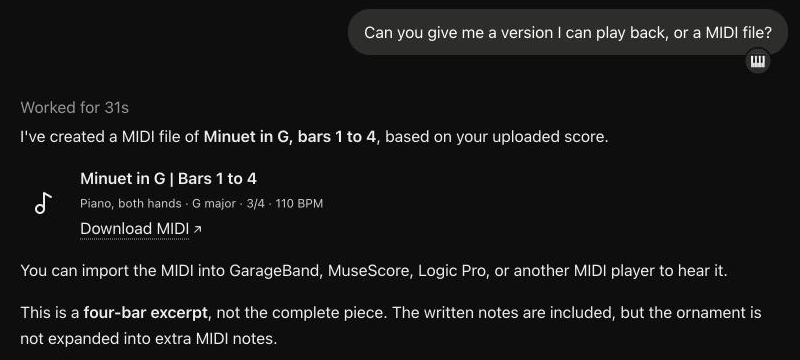
Asked directly for “a version I can play back, or a MIDI file”, the model wrote ABC notation, a text format for music, and suggested pasting it into an online ABC player. The ChatGPT app did more: it used its code tools and offered a MIDI file of bars 1–4 to download. That file is the model’s reading turned into notes, so it carried the same wrong note in bar 3, and it covered only the four bars we had asked about. There was still no MusicXML and no score to see or edit; to fix a note you would open the MIDI in other software or ask again.
Why is sheet music hard for a chat model to read?
Because one symbol means different things depending on where it sits. The same black notehead is a G or a B depending on its line, and the clef, the key signature, an accidental earlier in the bar and an octave sign all change it. Reading a page means getting all of those right for every note at once. A general model that describes a picture well can still be one line off, and on a photo the lines themselves bend and fade.
Reading the same score with ScoreStarling in ChatGPT
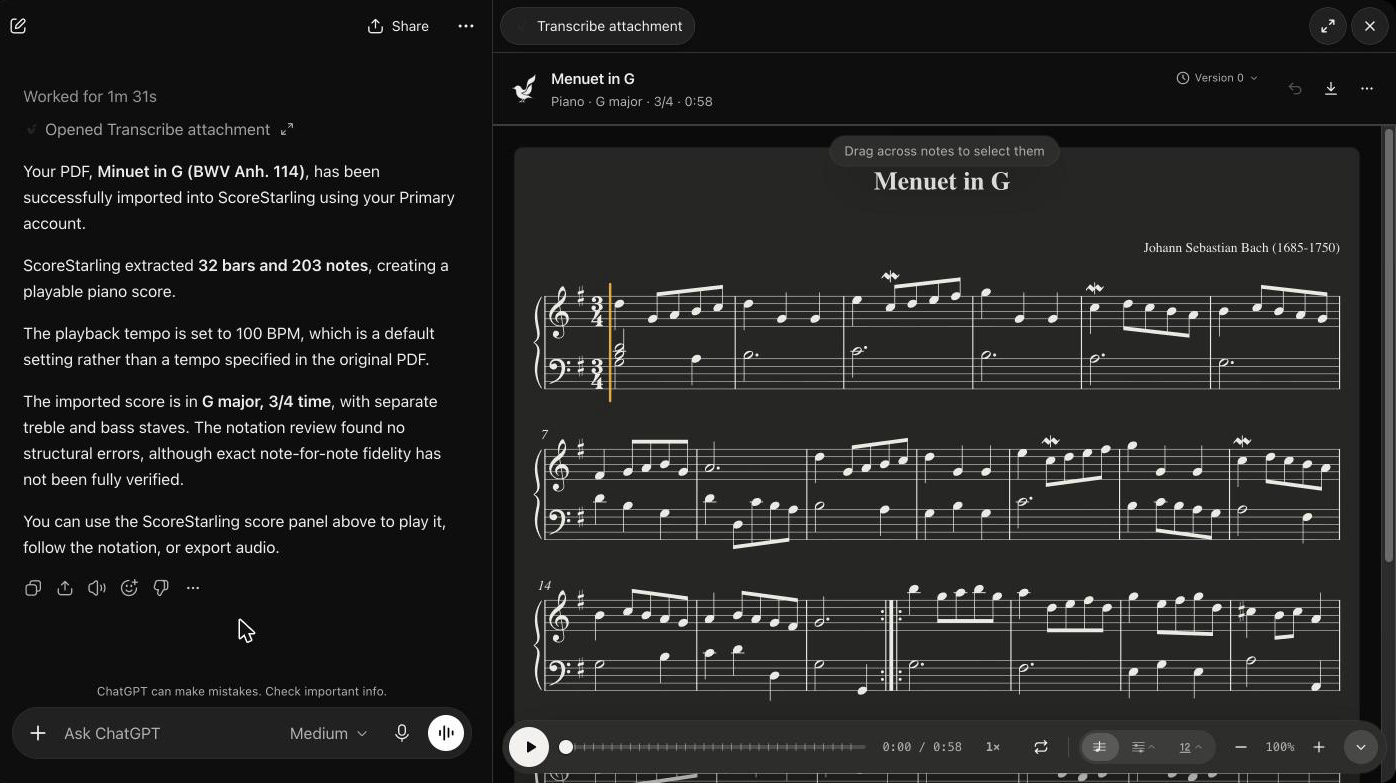
ScoreStarling connects to ChatGPT and Claude over MCP, as the connection guide shows. A clean PDF goes to a sheet-music reader (optical music recognition, built on the open-source Audiveris), which turns the page into a score; the assistant then compares that score with the page and fixes what it misread.
A clean PDF
The reader got all 101 notes of the minuet’s bars 1–16 right, and all 91 notes of the Chopin excerpt, with the right key and time signature. It missed one thing: the grace note before bar 8 of the minuet. The result opened as a score we could play back at once, transposed to F major in one step (all 32 bars, key signature included), and downloaded as MusicXML, MIDI, PDF and MP3.
A phone photo
The reader failed on our angled photo: it found 12 bars and 56 notes out of 203, split the piano into two instruments and wrote the key as C major. ScoreStarling handles photos, handwriting, jianpu and lead sheets another way: the assistant reads the picture and writes the music as ABC, and ScoreStarling makes a playable score from it. That is only as accurate as the assistant’s reading. When gpt-6.1-sol did it, its first version had 6 wrong notes, in bars 7 and 8. When we then asked it to compare its score with the photo, it missed those bars, decided the left hand was an octave too low and moved it, which left 43 notes wrong.
The page
After the model “checked” its photo reading
If you can, give the reader a PDF or a flat scan. A phone’s document-scan mode, which straightens and evens out the page, is closer to a scan than an ordinary photo; we haven’t measured how much it helps.
Results side by side
| Method | A. Clean PDF (101) | B. Phone photo (101) | C. Chopin (91) |
|---|---|---|---|
| gpt-6-astra alone | 1, 2, 1 | 13, 1, 1 | 0, 0, 0 |
| gpt-6.1-sol alone | 1, 5, 0 | 11, 37, 18 | 0, 0, 2 |
| gpt-6-sol alone | 5, 1, 5 | 16, 13, 7 | 14, 42, 9 |
| gpt-5.6-sol alone | 5, 5, 3 | 23, 19, 22 | 36, 59, 39 |
| gpt-5.6-terra alone | 4, 37, 5 | 20, 2, 1 | 2, 13, 2 |
| gpt-6-luna alone | 62, 58, 58 | 67; declined twice | 52; declined twice |
| gpt-5.6-luna alone | 87, 97, 86 | 84, 110, 93 | 91, 79, 85 |
| ScoreStarling reader | 0 (one grace note missed) | failed: 12 bars, 56 notes, wrong key | 0 |
| gpt-6.1-sol writes ABC, ScoreStarling makes the score | — | 6 first; 43 after its own check | — |
| ChatGPT alone | ChatGPT with ScoreStarling | |
|---|---|---|
| Key and time signature | Right in every answer | Right from the PDFs; wrong from the photo |
| Playback | ABC text, or in the app a MIDI file to open elsewhere | Plays in the chat’s score panel; MP3 download |
| MusicXML and MIDI | A MIDI file of the bars it read, in the app; no MusicXML | Yes, once the score is unlocked |
| Transposed result | A list of notes and ABC | A transposed score to play, edit and download |
How to check any AI-read score in three minutes
Whatever read the page, treat the result as a draft and spot-check the places where readers slip.
- Compare the key signature, time signature and the first bar’s notes with the page.
- Look for a whole bar shifted up or down one step: compare its first and last notes with the page.
- Check accidentals in the middle of a bar and whether they carry on to later notes in it.
- Check the lowest left-hand notes for octave mistakes.
- Count the beats in a few bars with dotted notes or ties.
- Look for missing grace notes, ornaments and repeat signs.
- Play it back while following the page; wrong notes are easier to hear than to see.
Claude and other assistants
We scored only ChatGPT models here. Claude also reads images and can connect to ScoreStarling over MCP the same way, so the reader, playback, transposition and downloads work there too.
What does reading sheet music with ScoreStarling cost?
Reading a PDF or picture is free: no credits for reading, editing, listening or a new PDF. MusicXML and MIDI need the score unlocked, 15 credits once per score, and every account gets free credits each month (checked October 13, 2026). Turning a recording into sheet music is a different job, covered in Can ChatGPT make sheet music from a song?
Sources
- Mutopia Project, Menuet in G, BWV Anh. 114, typeset by Allen Garvin, public domain.
- Mutopia Project, Walzer Nr. 10 h-moll, Op. 69 No. 2, typeset by Roland Goretzki, public domain.
- Audiveris, the open-source optical music recognition engine behind ScoreStarling’s reader.
- The ABC music standard.
Questions and answers
Can ChatGPT read a sheet music PDF?
Often, if the PDF is clean and the model is a strong one. In our October 13, 2026 test, gpt-6-astra read 16 bars of a Bach minuet (101 notes) with 1, 2 and 1 wrong notes in three tries, and gpt-6.1-sol with 1, 5 and 0. The weakest of seven models got 86 to 97 wrong. Check the notes before you rely on them.
Why does ChatGPT get notes wrong on a photo?
A note’s pitch is its position on the five lines, so a tilted or shadowed photo makes it easy to count one line or space off. In our test the typical mistake on a photo was a whole bar read one step too high or too low. Even the best model got 13 of 101 notes wrong in one of three tries; others got up to 37 wrong.
Can ChatGPT transpose sheet music?
It can transpose the notes it read and write them out as a list or as ABC text. When its reading was right, its transposition of eight bars from G to F major was right too. What you get is text, not a score file you can open in notation software.
Can ChatGPT convert sheet music to MIDI?
It can make a MIDI file of the notes it read, mistakes included. In the ChatGPT app on October 13, 2026, it wrote a MIDI file of bars 1–4 that carried its one wrong note; asked directly without the app’s tools, the model wrote ABC text instead. Connected to a sheet-music reader such as ScoreStarling, the same chat can return MIDI and MusicXML of the whole page.
Can Claude read sheet music?
Claude can look at images of sheet music too; we didn’t score it in this test. Claude can connect to ScoreStarling over MCP in the same way as ChatGPT, so the reading, playback and exports below work there as well.